Posts

Showing posts with the label science fiction
Image
THE INVISIBLE MAN . H. G. Wells. First published in 1897. Although written over a hundred years ago,   The Invisible Man   is written in a very accessible style and fast pace. The inn he stumbles into at the opening is not the Lion's Head as in the film, but the Coach and Horses. There is some humor in the book, but certainly not as much as in   Whale's film version. There is no love interest to speak of, and the protagonist, Frank Griffin, winds up in the home of Professor Kemp, whom he knows, by accident. In the film Griffin is driven crazy by an ingredient in the invisibility formula, but in the novel he's pretty much a self-absorbed sociopath from the beginning. He doesn't derail any trains -- although he does plan to embark upon a "reign of terror" -- but he does murder one man and attack many others. This is certainly not   Wells's   best novel, but it is fascinating, highly influential, and a good read to boot.

STAR TREK 365: THE ORIGINAL SERIES.

Image
STAR TREK 365: THE ORIGINAL SERIES . Paula M. Block with Terry J. Erdmann. Abrahms; 2010. This out-sized hardcover covers the original   Star Trek   series with William Shatner, although even fans may wonder if there's anything left to say about the show. Nevertheless, Block does manage to come up with some new and sometimes amusing observations about these original episodes. The book isn't in chronological order, which is a little strange, but a bigger problem is the unwieldy shape and heaviness of the book, not to mention the too small and light typeface, none of which, of course, is the author's fault. The book, however, is packed with big beautiful photographs, which may be the chief appeal to the   Star Trek   fanatic.

SCIENCE FICTION, FANTASY AND HORROR FILM SEQUELS, SERIES AND REMAKES

Image
SCIENCE FICTION, FANTASY AND HORROR FILM SEQUELS, SERIES AND REMAKES :   An Illustrated Filmography with Plot Synopses and Critical Commentary . Volume 1. Kim R. Holston and Tom Winchester. McFarland; 1997. Foreword by Ingrid Pitt. You gotta love a book that has a foreword by the one and only Ingrid Pitt of Hammer horror fame. But there's lots more to enjoy afterward, including synopses of hundreds of movies, along with a brief analysis of each film and interesting quotes from reviews both good and bad. There are also lots of photographs in this very thick volume, which covers everything (in more or less alphabetical order) from   The Abominable Dr. Phibes  to   Zapped Again , with stops along the way to look at multiple versions of   Invasion of the Body Snatchers , the   Halloween   and   Friday the 13th   films, Roger Corman's Poe series, the many, many Frankenstein and Dracula movies, and a whole lot more, covering the classics up to the ...

THE WAR OF THE WORLDS H. G. Wells

Image
THE WAR OF THE WORLDS . H. G. Wells. " In another moment the huge wave, well-nigh at the boiling point had washed upon me. I screamed aloud, and scalded, half blinded, agonised   [sic] , I staggered through the leaping, hissing water towards the shore. Had my foot stumbled, it would have been the end. I fell helplessly, in full sight of the Martians, upon the broad, bare gravelly spit that runs down to mark the angle of the Wey and Thames. I expected nothing but death."  " Surely if we have learned nothing else, this war has taught us pity -- pity for those witless souls that suffer our dominion. " H. G. Wells' 1898 novel   The War of the Worlds , besides bringing into being the whole genre of invasion from outer space and alien life forms, is a brilliant novel written in a style that is still quite vivid and accessible today despite its being a work of the 19th century. Wells' distinctive and descriptive prose brings to shuddery life a true horror and scien...

THIS ISLAND EARTH Raymond F. Jones

Image
THIS ISLAND EARTH . Raymond F. Jones. 1952. Fiction House Press. This novel which became the basis of the science fiction   film of the same title   was expanded from a story originally published in   Thrilling Wonder Stories  ("The Alien Machine"/1947) and its two sequels. The first half of the novel is quite similar to the film, in which a scientist, Cal Meachum, receives instructions to build an "interociter," which leads him to a secret conclave of people who seem to have some unknown mission. Although the protagonists in the book do eventually wind up on an alien planet, most of the second half of the movie is invented by the screenwriter. There's no decimated husk of a planet or mutated hulking monsters in Jones' novel. Instead Meachum learns that earthlings are simply being used to build interociters to help the aliens in a struggle against a dark intergalactic force which has now set its sights on Earth; Meachum and his lady love convince the aliens ...

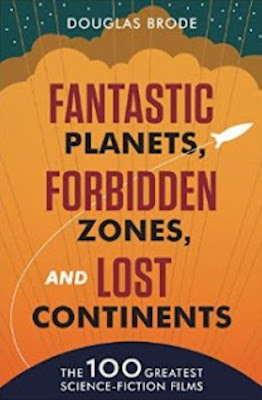
FANTASTIC PLANETS, FORBIDDEN ZONES AND LOST CONTINENTS: The 100 Greatest Science Fiction Films

Image
FANTASTIC PLANETS, FORBIDDEN ZONES, AND LOST CONTINENTS: The 100 Greatest Science Fiction Films.  Douglas Brode. University of Texas Press; 2015. Author Brode looks at 100 of the most influential, popular, and well-made science fiction films. There are chapters on such films as   The Invisible Man,   The Day the Earth Stood Still,   The War of the Worlds, Village of the Damned,   Seconds,   Alien, Star Wars,   Fantastic Voyage, Jurassic Park , and many others. This is more a book of reportage than of film criticism, as Brode's approach is to divide each essay, pop culture-style, into bold-faced sections: Background, Film, Plot, Theme, Trivia and Most Memorable Line. There is little analysis of the film's themselves. In addition to genuine classics, Brode seems to have a weakness for some of the more pretentious titles covered but he does come up with some interesting factoids on many movies. Heavily illustrated. This is an okay introduction to some me...

THE GREATEST SCI-FI MOVIES NEVER MADE

Image
THE GREATEST SCI-FI MOVIES NEVER MADE . David Hughes. A Cappella Books/ Chicago Review Press; 2001. This entertaining and well-researched book examines the struggle to get many science fiction films made, (some of which have since materialized since the publication of this first edition). These include efforts to bring to the screen such novels as Alfred Bester's "The Stars My Destination;" and Arthur C. Clarkes' "Childhood's End." More often the book examines how the scripts of certain films metamorphosed from the screenwriter and/or producer's original conception into something entirely different.   Superman Lives   (as   Superman Returns )   and   I am Legend   were eventually made, but in very different form and with different actors and creative people attached.   Spider-Man   eventually came to the screen but without the participation of James Cameron, who was attached to the project for several years. Then there are dissections of why certa...